
As another spring has “officially” come upon us, many people are thinking about spring cleaning inside their homes and cleaning their gardens preparing for planting; however, this is a great time to also take stock of our lives and the things that we need to declutter and clean out of our schedules, routines, and lives in general. Many of the podcasts, YouTubers, and Instagram personalities that I follow have been talking about one of those two things, cleaning their homes or preparing their gardens for planting, but what if we took this time of year to prune our schedules, routines, and lives by re-evaluating our goals and priorities?
I know that many of us sit down at the beginning of the year to set our goals, pick a word for the year, or map out a plan for the year. However, how many of us ever come back to look at those goals and plans to see how things are going? When it is time for spring cleaning around the home it is also a great time to take a look at those goals, plans, and intentions we set at the beginning of the year to see what is working, what isn’t, and why that is the case.
There are several areas of our lives where we could start, and it is tempting to start with the physical clutter of our homes. While this is what is most tempting, it makes more sense to sit down with our goals, plans, and intentions to see where we stand. Having an idea of how our goals, plans, and intentions for the year are going will help direct us as we prune and declutter our schedules and physical items.
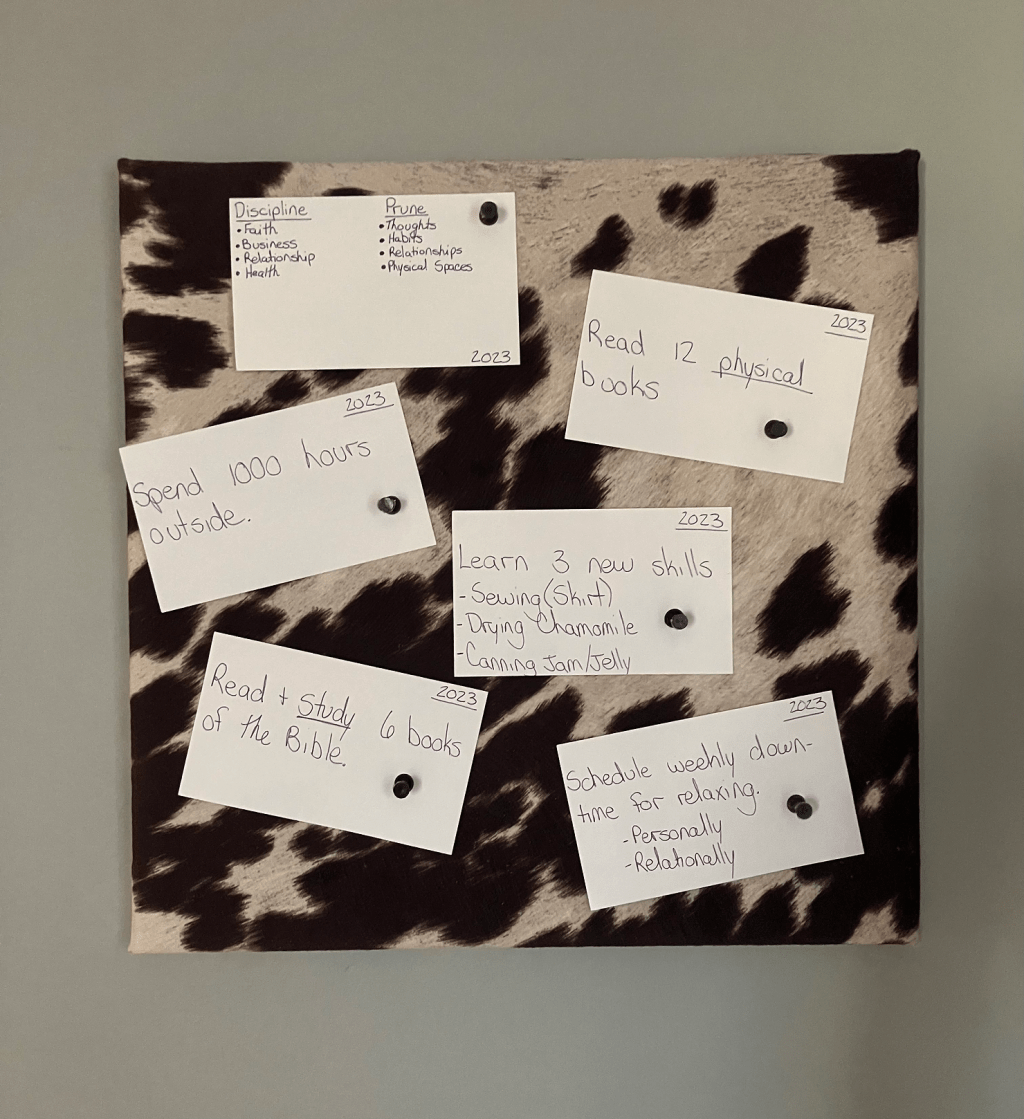
To check in on how our goals, plans, and intentions for the year are going, we must first have them written out where we can see them. If this is not something that you did at the beginning of the year, it is a good idea to do it now because it not only gives you an outline of areas in your life to focus on but research shows that you are more likely to achieve a goal if you have written it down. In fact, you are 1.2 to 1.4 times more likely to achieve your goals if you write them out “vividly”. Writing them down does not have to be fancy, and most of my goals are written down on notecards that I pin to a bulletin board above my desk.
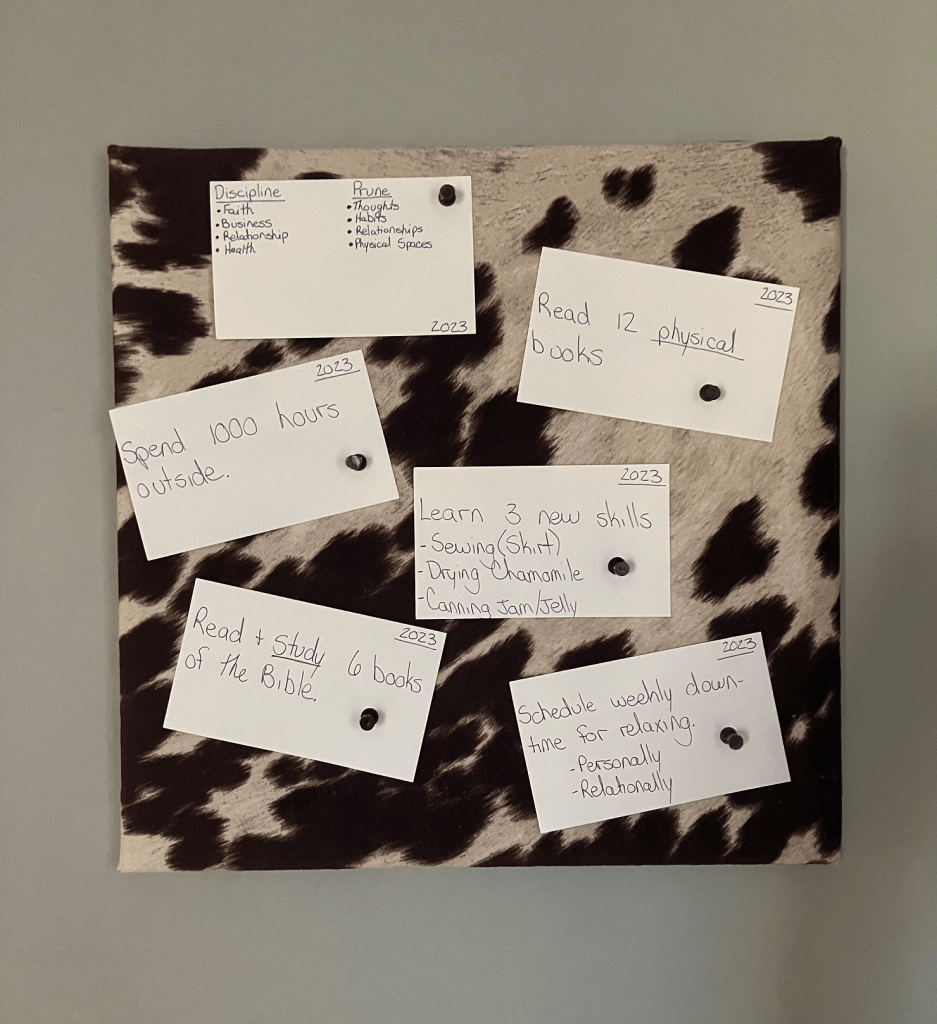
Once you have your goals written where you can see them, go through each one to see the progress that has been made toward achieving that goal. Personally, I find it most helpful to start with the goals that are habit or routine related such as screen time limits, reading, exercise, and eating habit related goals. For each goal go through the following steps:
- Write down how much you have progressed toward the goal, if at all.
- Write down the things that have helped you to get closer to the goal, or if you haven’t gotten closer to the goal, what are the reasons. (Be honest with yourself here and try not to make excuses such as “I don’t have the time.” Be more specific by looking deeper into why you feel like you don’t have the time such as “I feel like I don’t have time because I spend 3 hours each day on my phone scrolling through social media.”)
- When you have the things that are working or are not working, take note of those items. Be sure to keep doing the behaviors that are working and find solutions to the behaviors that are not working. (For example, if you feel like you don’t have time because you are scrolling on social media for 3 hours each day, set screen time limits on your phone so that you cannot access social media for more than 30 minutes each day.)
One thing that can be a struggle is feeling like you don’t have time to do things, but having no idea where all the time in your day is actually going. To help alleviate this, you can create a widget on the main page of your phone that would show how much screen time you are engaging in each day along with the 4 apps you spend the most time using. You can also set screen time limits for several applications so that they won’t be as much of a distraction in you day. Just these two things can help a lot to to cut back on the amount of time spent on social media each day.
Once, you’ve made adjustments to your habits and routines, you have the framework for what type of activities and items you want to allow into your life and home. This gives you the building blocks to start pruning things like subscriptions, your budget, and your schedule. It can be eye-opening to do a close audit of your finances to see how much is being spent on subscriptions, especially if you aren’t even using those subscriptions anymore. This is also a great time to prune physical and electronic documents. I tend to acquire far more documents than I intend, and this is a great time to re-evaluate what documents I actually need and which documents are simply creating clutter or taking up space. Even organizing your documents into binders or folders can help improve the space they take up, not to mention make them easier to find when you actually need them!
About once every 3-4 months, but especially in the spring, I try to go through my kitchen to find food that has been pushed to the back of cupboards and forgotten. This helps to catch any food before it has a chance to go stale in the back of a cupboard which helps to minimize our food waste. While in the kitchen, it is a good time to go through dishes and utensils that are not being used and place those items away in a tote. After another six months to year, if those items have not been used or missed, they get added to the donation box. Keeping them in storage helps to alleviate regret about getting rid of a utensil that is actually used, and keeps you from having to buy a new one in the case that you really do use that item.
A similar method is good for going through clothes, shoes, and jewelry as well. Often there are items in our closets that we don’t really care for or that never get worn for one reason or another. These items can be added to a basket in the back of the closest or stored away in a tote for six months to a year before deciding to donate if you are worried you will miss the item or regret getting rid of an item.
While personally I am a big book collector, I still find that I have some books I do not wish to reference or read again. However, they still seem to find their way onto the bookshelf where they will sit collecting dust and not getting read or used by anyone. When this starts to happen it has become a habit each spring to go through the books and pull out the ones that are not being read or referenced. This can also be a good practice with children’s books as kids get older and more mature, out growing books!
While these aren’t all the areas that get pruned and cleaned in the spring, they are the largest areas that seem to add up no matter how much we try to keep them thinned down and less cluttered. Since there always seems to be extra clutter, and it also appears that most of it gathers during the cooler months when we are forced inside without much to do, it has become standard practice to declutter and prune not just our home but our calendars, habits, and routines each spring.
 Cora's Cottage
Leave a comment