
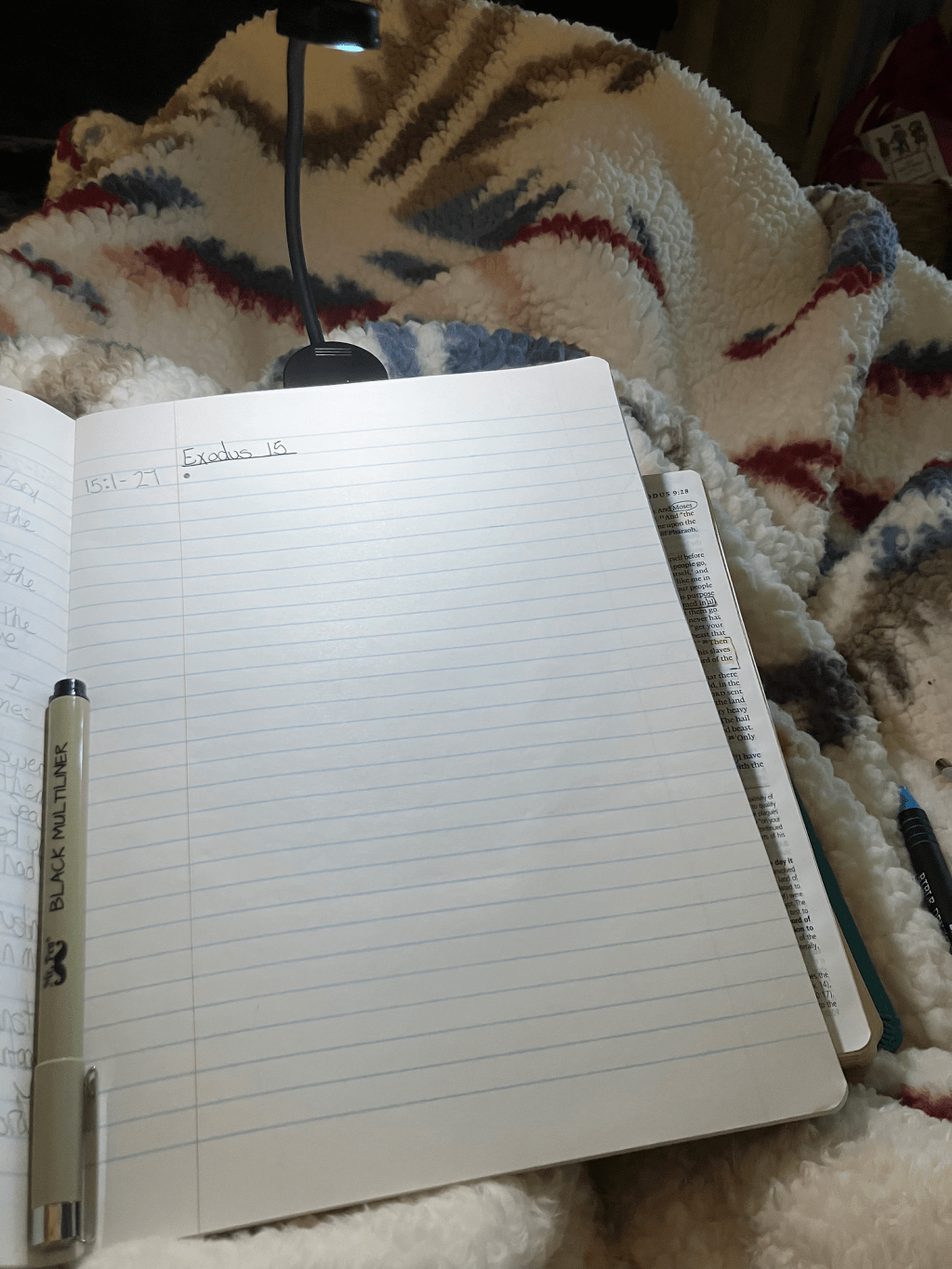
The infamous morning quiet time is something I have been chasing for years. Every time I think that I am getting close, life shifts and my perfectly crafted morning quiet time comes crashing down.
I tried for a long time to make it look picture perfect like all the pictures we see on Pinterest or Instagram. I would curl up in my favorite chair with a fuzzy blanket, a hot mug of tea, my Bible, all my favorite highlighters and pens, and a pretty journal, but this was a rare occurrence. However, I have come to realize that setting such high expectations for my morning quiet time has been the biggest obstacle in being able to stick with a consistent morning quiet time.
Life would get crazy and I wouldn’t have time, or the desire for all the pomp and circumstance I had created around my morning quiet time . . . so I just wouldn’t do a morning quiet time at all. During my most recent crazy season, I was able to figure out the keys to sitting down for my morning quiet time even when I didn’t feel like it.
These are the 5 practices that I found work well for me to stay on track with my quiet time, so try out what might work for you and leave what doesn’t. Try a lot of different things, research and experiment with different products and processes, and most importantly, don’t hang onto a product or processes that isn’t helping you as you sit down for your morning quiet time.
Expectations
The biggest, but most profound shift I made to start consistently sitting down for a quiet time was my mindset around quiet time. I had expectations that didn’t make any sense for my season of life, or any season of life for that matter. I always wanted the picture-perfect quiet time where I could sit down in a comfy chair with a big fluffy blanket by an east-facing window overlooking a grassy meadow as the sun rose. Multiple versions of the Bible, as well as, a Greek and Hebrew keyword bible, a journal, and all my favorite note-taking tools neatly tucked in my lap. Oh, and of course a hot steamy cup of my favorite tea on the end table beside me while the house was still perfectly quiet, and I felt completely un-rushed. (Ideal pipe dream, I know.)
That picture that I had idolized in my head kept me from even attempting a quiet time for way to long. When I finally did start doing a quiet time, it looked nothing at all like the idea I had in my head, which was discouraging at first but as I continued to consistently sit and read the word of God, I started to find myself desiring to do more and more of just that, diving into God’s word.
We all lead busy lives, with a million different commitments and responsibilities pulling us in a million different directions at breakneck speed, which is all the more reason why we need to prioritize a quiet time, even if it isn’t so quiet. This is why I am trying to embrace studying my Bible in loud and noisy places on days my ideal quiet time doesn’t work. While I have a preferred method and setting for having my quiet time, some days that looks like doing it in a loud and crowded coffee shop, or while I sit and wait for the car at the repair shop.
While I have not had the honor and joy of experiencing motherhood yet, I have heard from a handful of mom’s that one of the best ways they know to get their quiet time in during the day is to actually include their kids. Taking time after breakfast to sit and read the Bible out loud to their children, even if they aren’t really old enough to fully understand the good news they are hearing. This is a practice that I hope I can implement with my children one day because it is such a beautiful way to express the importance of God’s word in our lives to our children.
Ultimately, in comes down to not putting so much pressure on ourselves to have the perfect quiet time whether that is the location, the atmosphere, the style of study, or anything else. All we really need to be in God’s word is a Bible.
Audio Bible
While all we need is a Bible, I have found it is helpful to also have an audio Bible available for two reasons. First, some days, it is just not in the cards to physically sit down and read my physical Bible, but I can listen to the Bible. Secondly, my mind can sometimes wander if I am just reading the Bible in my own head, so I have an audio Bible in the same version read the passages to me while I follow along in my physical Bible. Both of these help me to be in God’s word daily, as presently as I can be.
One of my favorite apps for listening to the Bible is YouVersion. YouVersion has several translations in the audio version, and if you don’t have your physical Bible you can always follow along on the app as it reads to you. You can also download versions you like so that you don’t have to have wifi or service to use your chosen version. Another app I have heard many people use for audio Bible readings is Dwell. I have not given Dwell a try yet, but I hear high praise for it from many people. The one thing I have noticed from looking into Dwell is that, unlike YouVersion, it is either a paid subscription or a one time price for lifetime access as opposed to being free.
Note-Taking Plan
Taking notes of key themes, terms, trends, lessons, or other things that stick out to me while I read scripture helps me to stay focused, but so does having a plan for all these notes. I am by nature a notetaker who wants all the details, but this made my notes messy and distracting to I had to sit down and figure out a note-taking plan that would help me keep all the elements organized. For me this means I keep general themes, terms, timelines, trends, and lessons of the book of the Bible I am reading in one notebook while I keep things I want to research more or terms that I need to dig deeper into in the original Greek or Hebrew in another notebook as a list.
This system has worked well for me, but it has taken some trial and error and is still evolving. There are all kinds of guided journals on Amazon, as well as, Bible study templates and methods that you can try to find what works best for you. While I am someone who loves all the notes, it is not necessary to love taking notes to have note-taking be beneficial. For example, if you find your brain drifting away while you are reading the Bible you can start to take notes on the points, themes, characters, and lessons to keep you focused on what you are reading. As you are going through scripture, ask yourself questions to answer in your journal. One question I often ask myself as I read is if I can better exemplify the same vigor for Christ as those in the Bible or do I exhibit the same types of sin being revealed.
Your Favorite Drink
Even if it has to be in a travel mug, this is one small joy that helps make my quiet time feel warm and cozy no matter where I am doing it. I have found that linking my quiet time to another habit that I do no matter how rushed I am, like drinking my morning tea, helps me start to build the muscle of habit and routine for quiet time.
Begin and End with Prayer
Starting and ending my quiet time in prayer makes a huge difference; however, I am far from perfect on this practice. When I pray over my study of the Word before I begin, it helps to create a mindset shift that makes it easier to concentrate on the words I am reading rather than the to-do list running through my head. This prayer doesn’t need to be long and grandiose, often times I only pray a sentence or two before I begin my study. (I usually just ask the Lord to guide my reading and open my eyes to what He wants to teach me.) When I am done with my study, I thank the Lord for something from the study whether that is a new fact I learned, a new term I can add to my vocabulary, or a lesson He is revealing to me. Some days, I take this time to pray through my prayer list, or talk to God about an area of my life in which I have been struggling or am seeing great fruit. Again, this prayer doesn’t need to be long and grandiose. As you get more comfortable praying and talking with God, your prayers will likely get longer and seem much less daunting which is what I have found to be the case.
While this, just like the 5 tools I use for a successful “quiet” time is not an extensive list of the practices I try to implement to make my quiet time successfully happen, it is a list of the practices that have made the most impact. Of course, each person is different and will need different methods to help them, but it is important to remember that the one key thing that is true in every quiet time is that the only thing truly needed is a Bible.
 Cora's Cottage
Leave a comment