
Disclosure: This post contains affiliate links and I may earn a small commission at no additional cost to you when you use a link.

With spring “officially” here on the calendar and slowly deciding to make its presence in the milder days and warmer temperatures, many people have already started seeds or are preparing to direct sow when the soil temperatures warm up. With planting, I get curious about the specifics of each plant from the history to uses and everything in-between. So, each night I’ve been curling up with homestead and garden books, blog posts, and gardening sites to learn everything I can.
The first topic of research was tomatoes because they are a staple in my garden, and in the garden of my parents while growing up. Starting in “The Encyclopedia of Country Living” by Carla Emery and The Self-Sufficient Life and How to Live It by John Seymour for my research, I got a good baseline (and then some!) as well additional resources and recipes for learning about and using tomatoes.
Tomatoes are known as Lycopersicon lycopersicum or Solanum lycopersicum in Latin and originated in South America. Having originated in South America they are not a frost hardy plant and are naturally a tropical perennial that has gone through rigorous selection processes to be more hardy. While tomatoes are naturally a tropical perennial they are grown as an annual in temperate climates like the temperate climate in which I live in zone 5a. Scientifically, tomatoes are a fruit; however, they can be used as either a fruit or vegetable. At one point the debate around tomatoes made it all the way to the Supreme Court. In the 1893 case Nix v. Hedden, the Supreme Court ruled that tomatoes are a vegetable in trade and commerce when ruling on the case that originated from a tariff law.
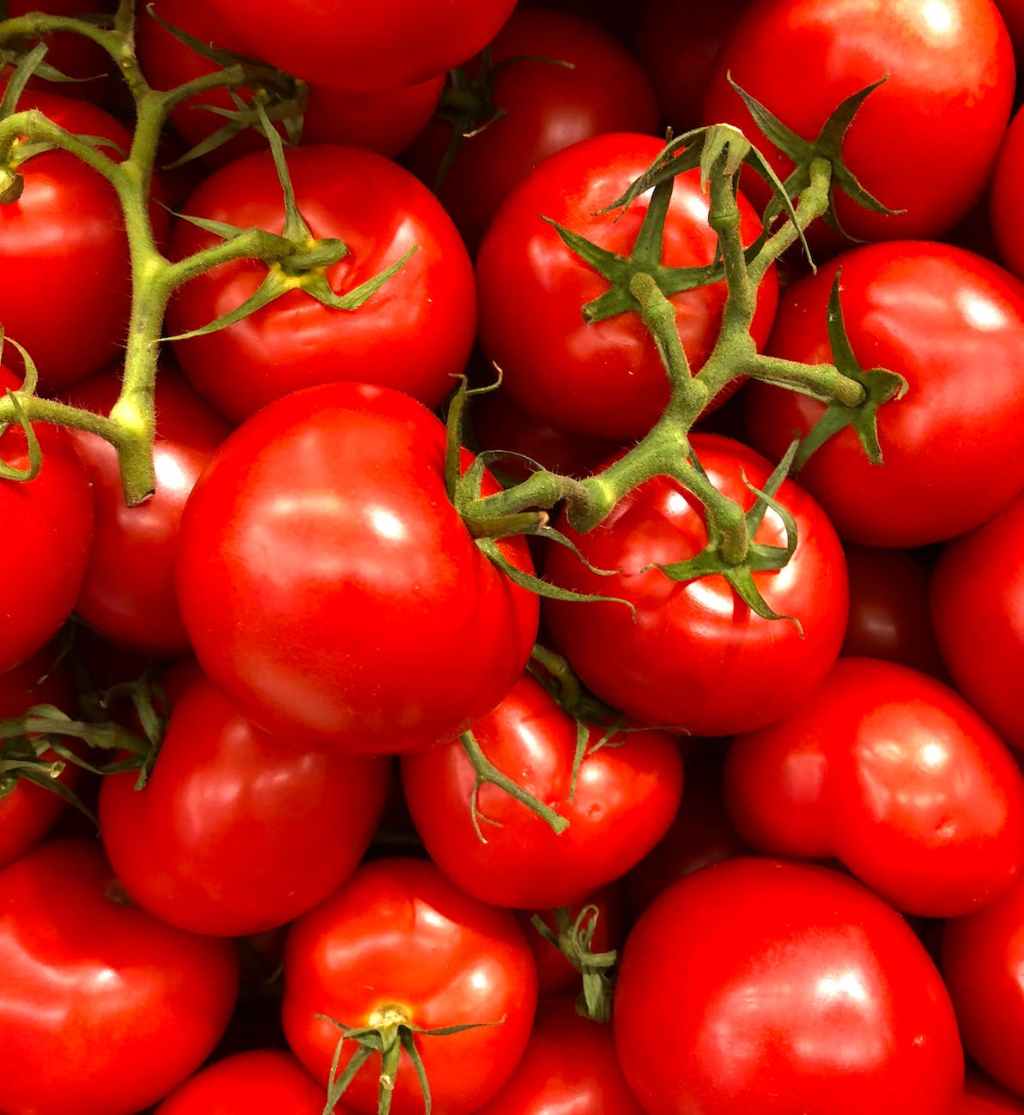
Tomatoes come in many shapes, sizes, colors, and textures. Colors include (but are not limited to) red, orange, pink, green, purple, white, and their original color yellow. Tomatoes can have smooth or fuzzy skins and range in size from a marble to 1.5 pounds! The fruit can be juicy or have a more solid, meaty interior, and they can be found with or without seeds. The plants are naturally trailing, but when staked or caged they can reach up to 6 feet tall, though there are varieties as small as 18 inches.
Rich, heavy soil is best for tomatoes. They thrive most when they have plenty of nitrogen, potassium, phosphorus, potash, calcium, and magnesium which can be added before and during the growing season through fertilizer. Tomatoes are best planted between April and June depending on your growing zone, but they can be started indoors if you live earlier in a cooler climate or growing zone. When planting tomatoes outside, the soil temperature should be between 60 and 85°F. If you are planting your seeds outside, plant them generously and thin them out later. The seeds will take between 7 and 12 days to germinate. If you chose to start your tomatoes indoors, they should be kept at 70°F and transplanted to larger pots when they are 3 to 4 inches tall and again when they are 10 inches tall. When you are ready to transplant your tomatoes outside, harden them off for 10 day first by setting them outside during the day and bringing them in at night.
The best way to plant a tomato seedlings is by trenching. To trench plant your tomato seedlings, dig a hole that will allow you to lay the tomato horizontally underground until you get to its leaves. It is okay to pinch off the first couple of leaves at the bottom of the seedling. Tomatoes will grow additional roots out of the length of the stem that is underground. The distance between plants and rows will vary based on the amount of garden space you have available and the varieties you chose to plant but it can range from 2 to 6 feet apart for plants and 1 to 3 feet between rows. Tomatoes can also be planted in pots; however, they need at least 3-5 gallons of soil 12 inches deep per plant. Lick tubs from your local rancher work great if you live in a more rural area!
Tomatoes are naturally a trailing plant, but when staked or caged upright they can grow up to 6 feet tall. When caging or staking tomato plants, keep in mind that they may not produce as much as a plant that is allowed to trail; however, if room is limited they can be safely staked by planting a stake close to the tomato at planting, taking care not to damage the roots. As the plant grows, tie it gently to the stake using soft string or old stockings or rags. Be careful not to tie the plant to the stake too tightly or else the plant will be damaged. Caging the plant is also safe, and likely will produce more fruit than staking. To cage the plant, either buy a ready-made cage or circle woven wire. Place the cage around the plant and stake it down.
Tomatoes grown outdoors can get blight, typically caused by too much humidity. However, there are natural remedies and chemical fungicides that can help. Blight on a tomato can affect the leaves or the fruit, and is recognizable by brown spots. Tomatoes can also be plagued by cutworms which will bite the plants off just above the ground typically right after planting. To keep cutworms from destroying young tomato plants, place a cardboard collar about 3 inches tall around the base of the tomato after planting. As the tomatoes mature, tomato worms (Tobacco Hornworms) can become a problem. Tomato worms are about 1.5 inches long, green, and hairless with a horn on their tail. They cannot sting with the horn and they don’t bite, but they can wreck havoc on your tomato plants. They typically are found deep within the tomato plant, and the best way to get rid of them is to simply pluck them off the plants. Early morning is typically the best/easiest time to find them. Weeds can also be a struggle, but they can be prevented by using weed barrier fabric or plastic, or by mulching. Grass clippings can be a cheap and affected way to get a thick mulch to prevent weeds. When using something like grass clippings or wood chips, it is best to lay down a layer about 2 inches thick. If you do not want to use a mulch or weed barrier, you can till or hoe between plants to keep weeds at bay.
Tomatoes can typically begin to be harvested in July or August depending on your growing zone and are best when harvested complete vine ripened. Wait to pick them until they are a bright red and be sure to leave the stalk, or green top, on the fruit. Once a tomato has ripened to this point it is best to use or preserve it immediately to prevent it from going bad. Tomatoes can be preserved through freezing, drying, or in several different forms when canned. When the end of the growing season is near and you fear the first frost, you have two options. You can either try to cover your plants to keep them from getting frost, or you can pick all of the ripe, almost ripe, and even the nice green tomatoes. You can store the green tomatoes at about 45°F to keep them green or at about 70°F to ripen them. This method can help to prolong your season out to nearly thanksgiving.
Tomatoes contain many nutrients and have several health benefits. Vitamin C, potassium, vitamin K1, and folate(B9) are all found in tomatoes. In fact, about 28% of your daily vitamin C intake can be met with just one medium size tomato, healthy blood pressure and heart disease prevention are promoted by potassium, blood clotting and bone health are improved with vitamin K, and folate promotes healthy tissue growth and cell function. Additionally, some studies are showing that tomatoes can reduce the risk of stomach, prostate, and lung cancer. Prolonged consumption of tomatoes can also help to reduce sunburn by up to 40%. Other studies show that tomatoes can help to reduce bad cholesterol, lowering the risk of heart disease. Unlike most foods, tomatoes do not lose very many of these nutrients when preserved.
In the United State tomatoes are the most popular garden vegetable and it is easy to understand why. They are fairly simple to grow, they can be consumed and stored in many different formats, and they contain key nutrients that remain when preserved. If you are looking to start gardening a good place to start is with tomatoes because they are so versatile in the kitchen and are fairly simple to grow in the garden!
Resources
https://planthardiness.ars.usda.gov/
https://supreme.justia.com/cases/federal/us/149/304/
https://www.smithsonianmag.com/smart-news/even-supreme-court-maintains-tomato-vegetable-180963133/
https://www.healthline.com/nutrition/foods/tomatoes#benefits
https://www.gardentech.com/blog/pest-id-and-prevention/fight-blight-on-your-tomatoes
https://www.usda.gov/media/blog/2010/07/16/tomato-plant-diseases-and-how-stop-them
 Cora's Cottage
Leave a comment