
Disclosure: This post contains affiliate links and I may earn a small commission at no additional cost to you when you use a link.
Main sources for this blog include:
– The Encyclopedia of County Living by Carla Emery
– The Self-Sufficient Life and How to Live It by John Seymour

Carrots are another staple in my garden, partly because they require so little maintenance and because they are a favorite at the dinner table!
Carrots are a biennial crop, meaning that they naturally will live for two years. In the first year they store up nutrients in the root and then use those nutrients in the second year to produce seed. We are harvest carrots at the end of the first year, because in the second year they are no good because the root becomes woody.
Carrots are believed to have originated from Afghanistan; however, those carrots had a purple color. The orange carrots we commonly think of today likely originated in Holland in the 16th century. Carrots are an insect-pollinated plant and can be crossed fairly easily, which is likely how we ended up with the current day orange carrot.
There are many varieties of carrots and they come in several shapes, sizes, and colors. They can range from the common orange to red, purple, yellow, white, and black. Short-rooted carrots are better for shorter growing seasons and rocky soil while longer-rooted varieties are better suited for a slightly longer growing season with light, free-draining soil. The longer varieties can grow roots up to a foot long.
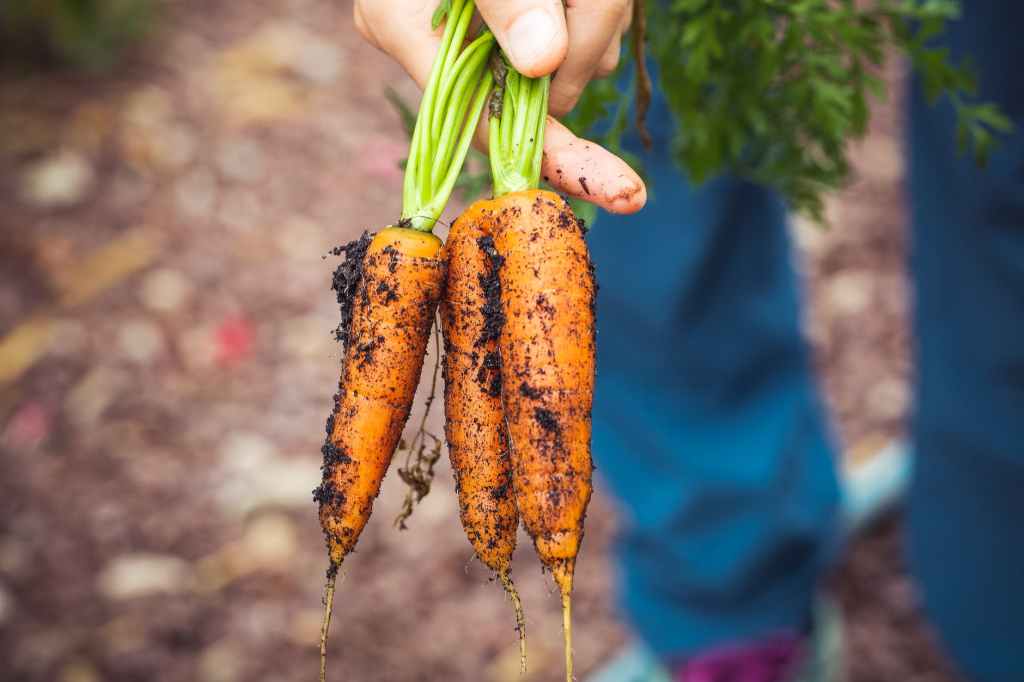
As a frost hardy plant, carrots can be planted up to 25 days before the last expected frost date. Carrots should be planted in deeply and finely tilled soiled to help the roots be able to grow freely. Planting in rocky soil can cause the carrots to end up growing in weird shapes that can be difficult when preparing them in the kitchen.
Plant carrot seeds 1/4 inch deep and 1/2 inch apart with at least a foot between rows. Carrot seeds are very small so this can be difficult, but do the best you can. Carrots will need to be thinned later, so getting the seeds closer together will not be too much of an issue. Once carrot seeds are in the ground, keep the area where they are planted well watered and moist until they come up.
The germination time on carrots is long, between 12 and 18 days, but it can help to soak the seeds in a little water overnight before planting. Because carrots take such a long time to germinate and sprout, it can be beneficial to plant something like radishes in the same row so that you can see your rows and begin weeding before carrots will sprout.
Thinning carrots will likely be an activity that needs to be done multiple times, but you can start to thin carrots when they are only 2-3 inches tall. It is a good practice to water the row before thinning and to thin so there is enough growing room between carrots. When thinning carrots be careful to break the carrot off underground. Any carrots that you pull while thinning can be eaten or preserved. Because carrots like loose soil, thinning carrots can be beneficial to the remain plants as it loosens the soil.
Carrots like to grow in cooler climates and require occasional watering. This is why it is best to plants carrots in the early spring and fall unless you have a very short growing season. When weeding carrots, it is best not to hoe too near carrots of in the rows as too much disturbance to the soil can disrupt the growth. Instead, weed within the rows by hand.
The main nutrients for carrots include nitrogen, phosphorus, and potassium. There are additional trace minerals that also help carrots grow including sulfur and calcium. The soil can be limed if very acidic; however, carrots can grow well in soil with a pH as low as 6.
I have not struggled with pests or diseases in my carrots thankfully; however, there are several diseases and pests that you should be aware of that might plague your crop. Carrot flies or carrot rust flies which lay larvae that can make tunnels in the carrot filled with rust filled mush. To help prevent carrot flies, soot can be applied to the soil after every rain, the soil can be turned deeply to allow birds to eat the larvae, intercropping carrots and onions, and a crop rotation.
Leaf blight is one of the most common types of diseases in carrots and is caused by fungus. There are couple different kinds, but usually they will all present with lesions on the leaves. They can be hard to prevent and treat, but if you struggle with leaf blight you can plant resistant varieties and treat plants with a fungicide. Good airflow can help to prevent some types of leaf blight. Other types of pests and diseases include dampening off, black rot, cottony rot, downy mildew, powdery mildew, cavity spot, aphids, carrot weevils, flea beetles, and nematodes.
From planting to harvest, the average carrot needs 70 days; however, they can be left in-ground all summer if planted in the spring or can be harvested when they are fully ready for harvest. I usually leave my carrots in-ground for the whole summer and harvest after the first hard freeze. I have found that leaving the carrots in ground until then tends to make them sweeter.
There are several ways to store carrots for the winter. They can be stored in wood boxes or galvanized tubs in-between layers of sawdust or moist sand. Carrots that are stored well in a cool area can keep all winter but even in less than ideal conditions they can keep for a few months. Carrots should be stored unwashed with their tops snapped off. They can even be stored in-ground, but this can be risky if you live in an area where it freezes hard as the whole crop might freeze if the carrots are not covered with enough mulch over them.
When you are ready to use stored carrots, they can be cleaned by using a copper mesh pad or a scrub brush. It is best to clean them under running water like in the bathtub. This can also be done in the yard with a garden hose, but it can be a long and tedious job so it is best to find a place that is comfortable.
Carrots can be frozen, dried, canned or used fresh. To use carrots fresh simply wash and peel if needed. Young, small carrots likely don’t need peeled, just like new potatoes. They are good raw or can be cooked and served with butter.
To freeze carrots, simply choose carrots that are 1/2 to 1 inch in diameter, clean, cut off tops, and peel. Cut the carrots into 1/2 inch chunks or sticks, boil, cool, and bag for the freezer. It is best not to use large carrots. Carrots from the freezer are not as good as fresh ones but are good for soups or to eat with some seasoning and butter as you would fresh carrots.
When drying carrots, it is best to use young tender carrots. They should be washed and peeled (if needed) just like carrots for the freezer. Cut into 1/8 inch slices and dry until tough in leathery or they can be steamed/blanched before drying. When you are ready to use dried carrots, reconstitute them by simmering in water until tender.
My favorite way to store carrots is by canning. To can carrots, prepare them as if for freezing then bring them to a boil in a pot of water. Ladle carrots into jars and cover with boil water before pressuring canning. Jars should be hot before packing the carrots into them. Salt can be added to jars, typically 1/2 teaspoon per pint and 1 teaspoon per quart. I like to add the salt after the carrots but before the boil water. There should be an inch of headspace when packing the jars.
Carrots are a very nutritious vegetable containing vitamins and nutrients like vitamin A, vitamin K1, biotin, potassium, and vitamin B6. Vitamin A is good for eyesight, immune health, growth, and development. Vitamin K1 is good for bone health while biotin is important for metabolizing fat and protein. Blood pressure can be controlled by potassium and vitamin B6 can help with the conversion of food into energy. While containing all these vitamins and nutrients, 100 grams of carrots contain 41 calories, 2.8 grams of fiber, .9 grams of protein, 4.7 grams of sugar, and 9.6 grams of carbohydrates.
Carrots are good at blood sugar regulation because of the their soluble fiber which helps to aid in the digestion of sugars and starches. Carrots can also help with a reduced risk of cancer, lower blood cholesterol, weight loss, and eye health. Carrots can be beneficial for weight loss because they increase fullness which subsequently reduces calorie intake as you do not need to eat as much to feel full in subsequent meals.
Carrots are a great addition to your garden if you are looking for healthy options that are fairly easy to store for winter. Carrots have a short growing season and a frost hardy so they can be grown in most climates and locations.
 Cora's Cottage
Leave a comment